GEO vs SEO: where they overlap, where they don't
Most teams already have an SEO motion. Here's exactly which parts carry over to AI search, which parts have to be rebuilt, and what to ship first.
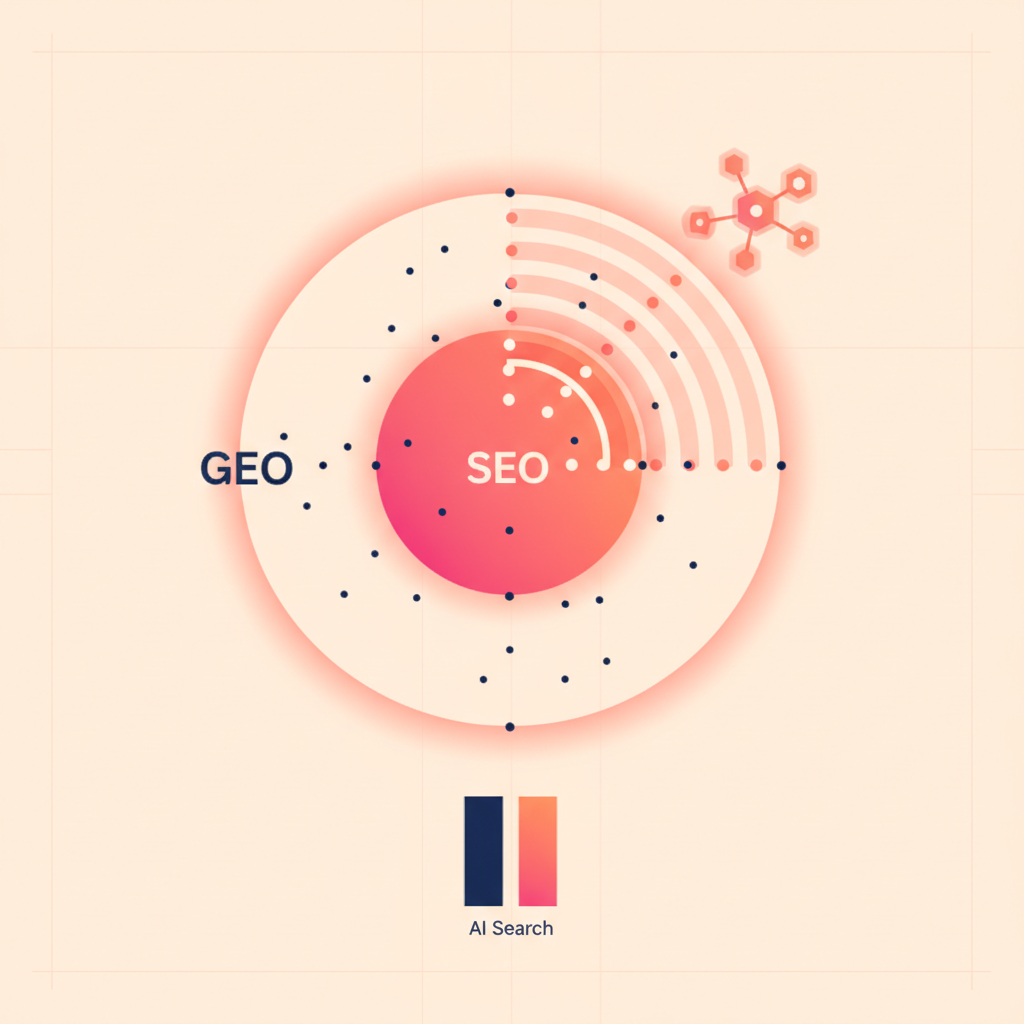
TL;DR: Generative Engine Optimization (GEO) and SEO share about 60% of their tactics — schema markup, page speed, clean information architecture — but diverge sharply on the other 40%. SEO optimizes for blue-link ranking. GEO optimizes for being named in an answer. Keep your SEO motion. Add the four practices below.
What carries over from SEO
If you have a functioning SEO program, most of it still earns you points in AI search. The fundamentals don't change: a fast, crawlable site with semantic HTML, clear information architecture and credible backlinks is the substrate every retrieval system benefits from — Google, Perplexity, Claude with web access, all of them.
Specifically, these SEO investments transfer directly:
- Technical SEO. Sitemaps, robots.txt, canonical tags, mobile rendering, Core Web Vitals. AI crawlers honor these signals.
- Structured data. Schema.org markup is more important for AI than for Google. Models lift facts from JSON-LD with high confidence.
- Quality content. A well-researched buying-guide page that ranks well organically will also be cited by AI — for the same reasons.
- Backlinks. Models calibrate trust the same way Google's PageRank used to: by counting which credible sources cite you. The currency hasn't changed, only the spending pattern.
Where GEO breaks with SEO
Four things change fundamentally when your goal is being in the answer, not on page one.
1. There is no SERP, so there is no ranking
You don't place "number three" in an AI answer. You either get named, or you don't. The distribution is binary, not ordinal. This changes the math of optimization: you can't improve from rank 8 to rank 3 incrementally. You're working to clear a confidence threshold the model has for "is this brand worth mentioning here?"
2. Keywords stop mattering; questions take over
SEO trains you to optimize a page for "best CRM small business". GEO is optimized for the actual question buyers ask — full sentences, in their voice, with context. Pages structured as question → answer pairs (FAQ, glossary, comparison) get extracted more often than pages structured as listicles. Use question-shaped H2s. Lead each section with the answer in one sentence, then defend it.
3. Citation sources become the leverage point
In SEO, backlinks are a vote. In GEO, the specific sources a model trusts to ground its answer become the leverage point. If models consistently cite G2, Forrester and one industry podcast when discussing your category, your job is no longer "get backlinks" — it is "get on those three sources". The actionable artifact of an AI-visibility audit is a list of the domains being cited about your category and your gap on each.
4. The output is content + structured artifacts, not pages
SEO outputs a blog post. GEO outputs a comparison page with a JSON-LD ComparisonTable, a glossary entry with DefinedTerm markup, a customer case study with Review schema, and a PR pitch to the three domains the models are already citing. The artifact isn't the prose — it's the prose plus the structured-data scaffold that lets a model extract it cleanly.
What to ship first if you're starting now
Assuming you already have a healthy SEO motion, here's the rank-ordered queue to add for GEO:
- FAQPage schema on your top pages. Highest extraction rate of any structured-data type. Twenty minutes of work per page.
- Comparison pages for each of your top three competitors. Format: You vs Competitor X for [persona]. Include a scannable comparison table.
- A glossary with five to ten definitions of the terms in your category. One definition per page, with
DefinedTermJSON-LD. - A SoftwareApplication or Product schema on your pricing page, with offers. Models lift pricing from this with very high confidence.
- Pitch the top three domains the models are citing about your category. Guest post, product review, expert quote — whatever opens the door.
How to organize the team
You don't need a new department. You need three small shifts:
- One person owns the SoM score. Usually the head of content or growth. They're accountable for the number moving up.
- Engineering ships the schema. JSON-LD, structured data, canonical tags. Once a sprint is enough.
- PR or partnerships own citation sources. Their target list is the audit's top-cited-domains report.
The bottom line
GEO is not a replacement for SEO. It's the next layer on top. Keep doing the SEO fundamentals. Add the four practices above. If your competitors haven't made the shift yet — and most haven't — you'll find a 6–12 month window where the ROI on GEO investments dwarfs anything else in the marketing stack.
Frequently asked questions
Does GEO replace SEO?
No — GEO is the next layer on top of SEO. Technical SEO, structured data, quality content and backlinks all still count; GEO adds question-shaped content, extraction-friendly structure, and a citation-source strategy.
What should I ship first for GEO?
In order: FAQPage schema on your top pages, comparison pages for your top three competitors, a glossary with DefinedTerm markup, Product/SoftwareApplication schema on pricing, and pitches to the domains AI models already cite in your category.
How is ranking different in AI answers?
There is no ranking — being named in an AI answer is binary. You're working to clear the model's confidence threshold for mentioning your brand, not to climb from position 8 to position 3.
Keep reading
- Share of Model
When AI Answers Your Buyers, Does It Mention You?
AI models name two or three brands when buyers ask for recommendations. If yours isn't one of them, you're invisible at the moment of highest intent. Here's how to measure it.
- GEO
Why GEO AI Visibility Is a Measurable Growth Channel
GEO AI visibility determines whether AI models name your brand when buyers ask for recommendations. This piece shows you exactly what to measure and where to start.
- Concept
What is Share of Model — and why it's the new SOV
Share of Voice was about media spend. Share of Model is about which brands AI considers obvious. Here's how to measure it without fooling yourself.